Description
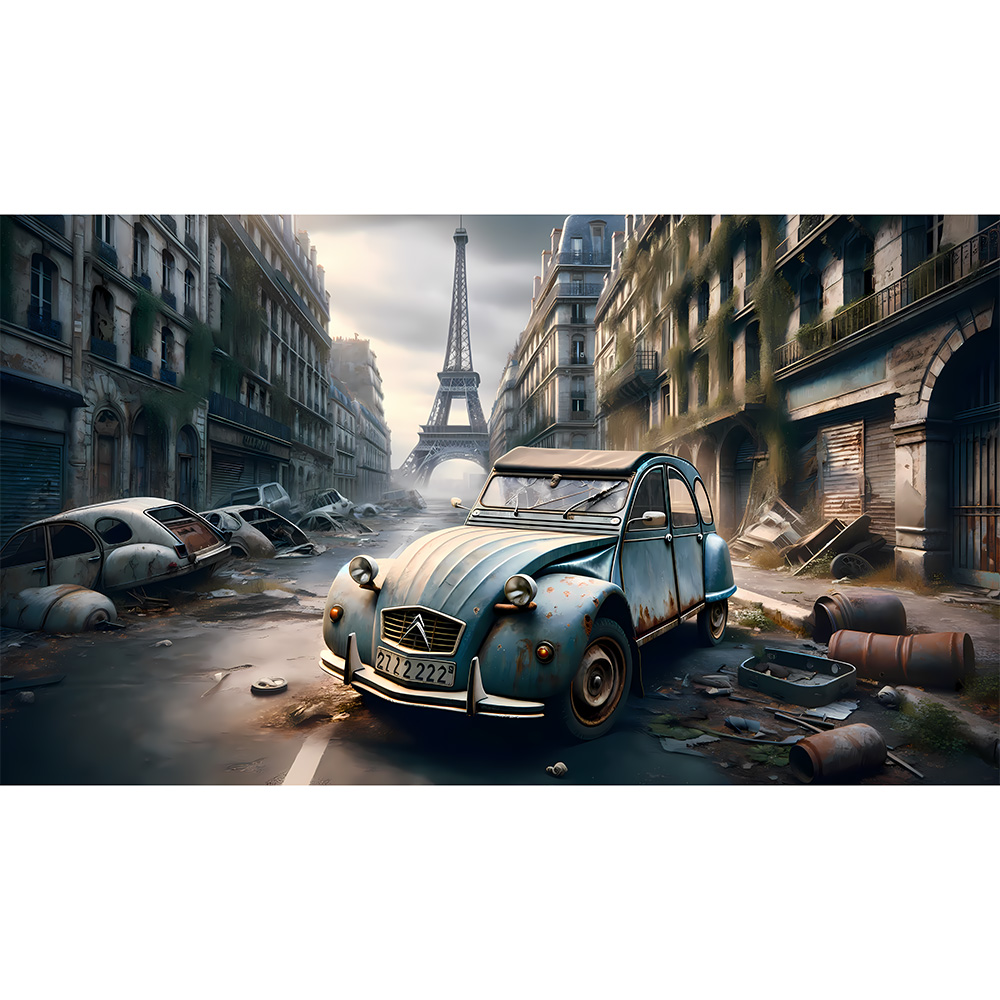
A haunting vision of history and resilience, this atmospheric artwork captures a weathered Citroën 2CV standing alone amidst the ruins of a deserted Paris. With the Eiffel Tower looming in the mist and derelict buildings flanking the street, the once-humble people’s car becomes a symbol of quiet defiance — a survivor in a forgotten world.
Rust, cracked paint, and scattered debris tell a story of time lost and beauty rediscovered. This piece blends vintage French charm with post-apocalyptic grit, making it a thought-provoking centrepiece for lovers of classic cars and cinematic storytelling alike.
️ Printed with a premium 12-colour process for exceptional texture, shadow, and detail
️ 250gsm semi-gloss paper enhances both the decayed ambience and vintage patina
Consistently rated 5 stars for mood, composition, and storytelling depth
Ideal for fans of the 2CV, urban explorers, and post-apocalyptic art collectors
A perfect blend of nostalgia and narrative — where rust tells a richer story than shine.
The Citroën 2CV, fondly known as the “Deux Chevaux” (two horses), is a significant icon in automotive history, celebrated for its simplicity and affordability. Here’s a brief history:
Concept and Design (1930s-1940s): The 2CV was conceptualized in the late 1930s by Citroën CEO Pierre-Jules Boulanger, who aimed to create an affordable, reliable car for the rural French population. The design criteria included being able to carry four people and 50kg of farm goods at 60km/h, and it needed to be versatile and economical. The development was interrupted by World War II, and the 2CV was finally launched at the 1948 Paris Motor Show.
Post-War Success (1950s-1960s): The 2CV became a symbol of post-war recovery and modernity. Its simple design, featuring a lightweight, air-cooled engine, front-wheel drive, and distinctive roll-back canvas roof, appealed to a wide range of users. It was particularly popular in rural areas, where its soft suspension handled rough roads well.
International Appeal and Evolution (1970s-1980s): The 2CV’s appeal spread beyond France, gaining a cult following in countries like the UK and Netherlands. During this period, Citroën introduced various models and special editions, including the 2CV Fourgonnette (a small van), the luxury “Charleston” edition, and the off-road “Sahara” model, which had two engines.
End of Production (1990): Despite its popularity, the 2CV’s basic design couldn’t keep up with modern safety and environmental standards. Production in France ended in 1988, with the last 2CV rolling off the assembly line in Portugal in 1990.
Legacy: Today, the Citroën 2CV is celebrated for its unique design, efficiency, and the role it played in motorizing the masses. It remains a beloved classic, with active clubs and enthusiasts worldwide. The 2CV’s influence is evident in modern minimalist and utilitarian vehicle designs.
Additional information
| Weight | N/A |
|---|---|
| Print size | 15×10 cm (6×4”) Paper, 18×13 cm (7×5”) Paper, 20×20 cm (8×8”) Paper, 25×20 cm (10×8”) Paper, 30×20 cm (12×8”) Paper, 30×24 cm (12×9”) Paper, 30×30 cm (12×12”) Paper, 35×25 cm (14×10”) Paper, 40×30 cm (16×12”) Paper, 40×40 cm (16×16”) Paper, 50×40 cm (20×16”) Paper, 50×50 cm (20×20”) Paper, 60×50 cm (24×20”) Paper, 60×60 cm (24×24”) Paper, 105×60 cm (42×24”) Paper |
Delivery
All prints are printed on demand and are usually dispatched within 3-5 days.
Smaller prints will be sent flat in card backed envelopes whilst larger will be rolled and sent in tubes.
Any import tax or customs duties if applicable, are payable by the buyer.
UK £2 – £7
Europe £4 – £11
ROW £4 – £17
(Price depends on print size and can be confirmed at checkout)
Paper prints
Printed to order on Epson 250gsm Ultrasmooth Fine Art Paper using an advanced 12 colour process giving beautiful quality and colour tones.
Canvas Prints
Printed to order on Epson 350gsm Satin Canvas using an advanced 12 colour process giving beautiful quality and colour tones.