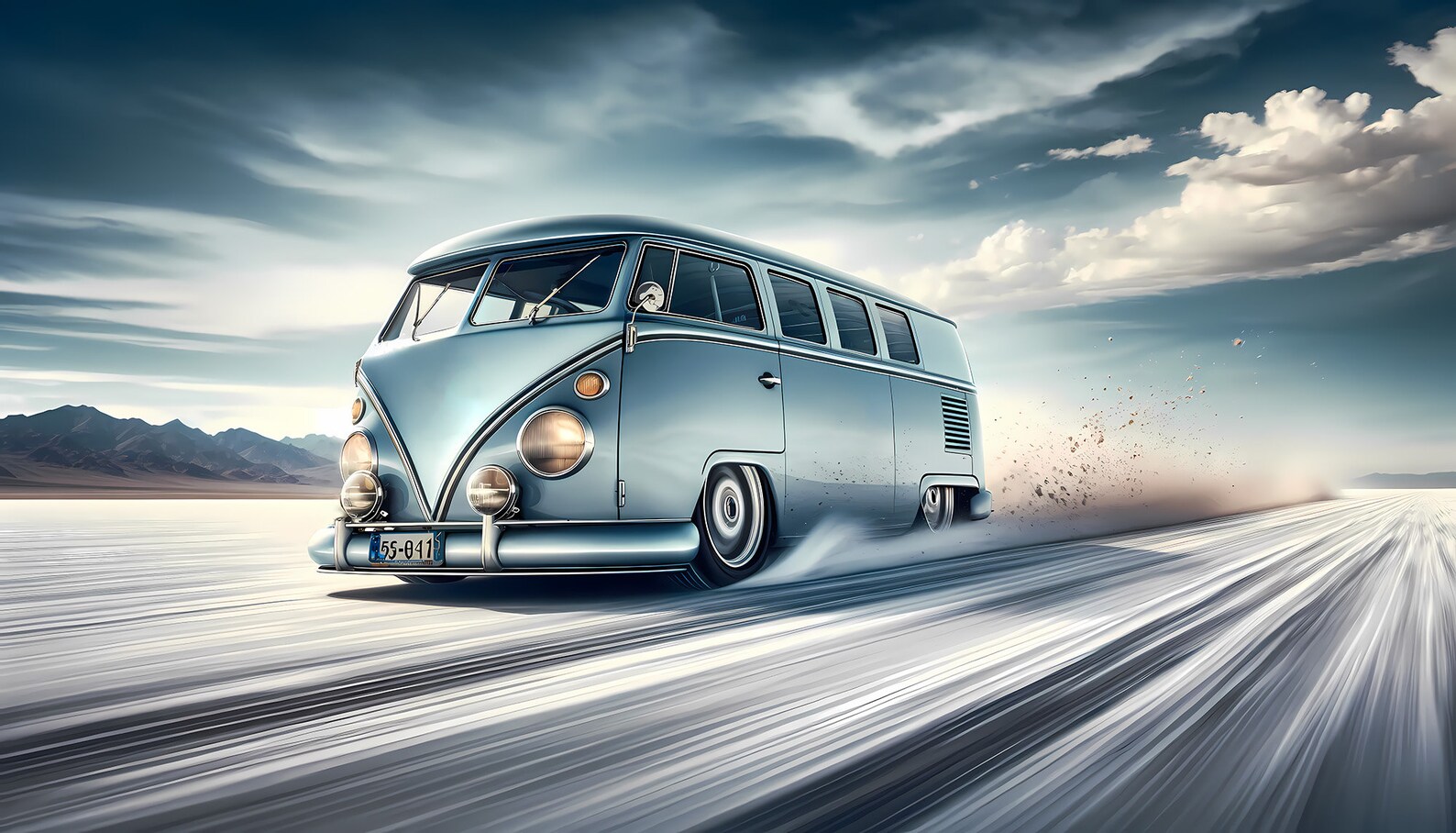
The Volkswagen Beetle harking back to the hippy days but in a modern surrealist style sat on a beach.
The print is supplied to fit all standard frame sizes but some cropping will occur dependant on size chosen – we NEVER crop the main feature image
All prints are manufactured to order and printed on a state of the art 12 colour Epson high quality printer and printed on premium semi-gloss photo paper.
Smaller prints are dispatched flat in board envelopes whilst larger prints are dispatched rolled in tubes.
Purchase PrintThe Volkswagen Beetle, also known in its native Germany as the “Käfer”, has a history that spans more than seven decades, beginning in the tumultuous 1930s and concluding with the end of production in 2019. Here’s a brief overview of its storied past:
Genesis (1930s):
The story of the VW Beetle starts with Ferdinand Porsche, who was commissioned by Adolf Hitler to design a “people’s car” (Volkswagen in German) that was affordable, simple, and reliable. Hitler’s vision was to mobilize the average German family by providing a cheap and practical car that could transport two adults and three children at a speed of 100 km/h (62 mph). The design criteria resulted in the creation of the Beetle, with its distinctive rounded shape, rear-mounted air-cooled engine, and rear-wheel drive.
Early Production and WWII (1938-1945):
The Beetle began production in 1938 at a new factory in Wolfsburg, Germany. However, its momentum was interrupted by World War II, during which the factory was repurposed to produce military vehicles. Production of civilian Beetles did not fully get underway until after the war.
Postwar Boom (1945-1960s):
After the war, the factory was under British control, and the car was rebranded as the Beetle. It began to gain popularity, first in Europe and then across the world, for its affordability and simplicity. The one-millionth Beetle rolled off the production line in 1955. The 1960s were the Beetle’s golden years; it became an icon of the era, symbolizing a spirit of freedom and nonconformity.
Emissions and Safety Regulations (1970s):
By the 1970s, the Beetle faced challenges adapting to new safety and emissions regulations, especially in the United States, which was its largest export market. In response, Volkswagen began to develop new models that would eventually replace the Beetle.
Global Production Shifts (1980s-2003):
Although the Beetle ceased production in Europe and the U.S. by the early 1980s, it continued to be produced in Latin America. The Mexican plant became the primary production facility for the Beetle, and the car remained popular in many developing countries due to its durability and ease of repair.
The New Beetle (1997-2019):
In 1997, Volkswagen introduced the New Beetle, a retro-inspired version built on the contemporary Golf platform. It echoed the original Beetle’s design but with modern engineering. The New Beetle enjoyed success and was later replaced by a second-generation model in 2011, known as the Beetle A5.
End of Production (2019):
Volkswagen announced the discontinuation of the Beetle line in 2019, with a final edition rolling out of the Mexican plant. The company cited a shift in consumer preference toward SUVs and the increased importance of electric vehicles.
Throughout its life, the VW Beetle became more than just a car; it became a cultural icon, appearing in films, and inspiring a devoted following. It’s a testament to simplicity and design efficiency, with over 21 million units produced, making it one of the best-selling cars in history.